
Where is the Solid Research on Starting Solids?
The Mushy Historical Justifications of Baby-Led Weaning

If you have thought in any capacity about feeding babies in the past five years or so, you have probably come across the great purée versus solids debates. If you have not waded into this swamp of shame and guilt, it basically boils down to what form the food you first feed your child should take. The two opposing camps are 1) spoon-feed the baby purées or 2) give them finger foods that they can eat and explore on their own—ideally a version of what the rest of the family is eating.
The latter method is called Baby-Led Weaning, and the idea is often attributed to Gill Rapley, who began using it in 2001. Around two decades later, the massively popular Solid Starts launched and really popularized the method.

But I am not here to debate the merits and downfalls of either feeding method. I’m not even here to talk about what I did with my kids. If you want to know my philosophy, I believe babies should be fed enough food to keep them alive and thriving and in a way that causes minimal anxiety for caregivers. Beyond that, I don’t care.
Instead, I would like to discuss some of the historical justifications of baby led weaning. While it would be perfectly fine to tout it as a good feeding method, many people across the internet have felt the need to promote it as a more “natural” way of feeding babies. Using history, they argue that baby-led weaning confers a variety of benefits that historical babies ostensibly displayed, particularly a lack of pickiness and thus more robust lifelong health because they will always prefer the taste of steamed broccoli to Ring Pops. Or something like that.
I wanted to dig into where this historical justification comes from. A lot of it, it turns out, can be traced back to the first part of one book: Inventing Baby Food: Taste, Health, and the Industrialization of the American Diet by Amy Bentley. It is unfortunate, then, that I found the first section of this otherwise informative book rather lacking in good history.
What is more unfortunate is that this information has been taken and twisted into an argument Dr. Bentley never made by big names in the baby-feeding sphere.
In this post, I am going to sort through some of the inaccuracies I found in Dr. Bentley’s work and the way it has been reproduced, and then go into what I think the the most important historical takeaway about baby feeding is.
The Chart That Launched A Thousand Questions
About a year back, I was listening to a podcast on the Baby Led Weaning debate. I can’t actually find it now, but in the episode, the hosts noted that scholar Dr. Bentley, in her 2014 book Inventing Baby Food, wrote that, historically, many children subsisted almost entirely on milk through age two.
Having fed—and fed and fed and fed—two ravenous little beasts myself, my first thought was that this could not be an accurate representation of Dr. Bentley’s work. Anyone who has met an actual human baby knows that they begin demanding food much, much sooner than that.
This little tidbit had me digging into the book, because it is all over the baby feeding internet. In fact, twelve out of fourteen citations on the Solid Starts article “History of Baby Food” are from Inventing Baby Food. And that’s not all. Search for the history of baby weaning and you will find Dr. Bentley’s chart again and again.
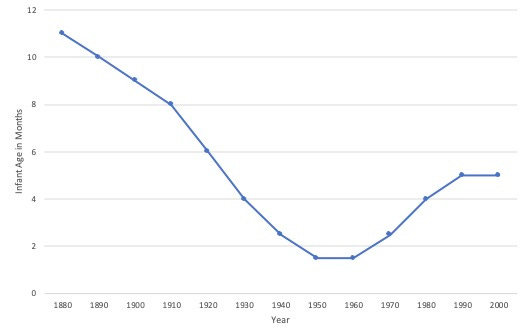
I am a citation hound so I just had to find the source that informed this chart, but when I went in search of it, I was disappointed. Dr. Bentley includes no citations for the figure. A bit weird, I thought, but not a deal breaker. The absence of a citation probably means she put it together based on her research, I thought. If I read the rest of the book, I reasoned, I should find where this comes from.
But I was wrong.
If she does draw it from her research, it’s not at all clear to me where. As far as I can tell, Dr. Bentley did not do any kind of quantitative historical research on the age of introduction of solids to babies—that is, she didn’t really crunch any numbers nor work off numbers someone else crunched. And that’s fine. A lot of historians don’t (including me most of the time).
If that is the case, however, you cannot produce a chart like this without some kind of qualification. At the most basic, I would love to know why the chart starts in 1880. In history, just to state something obvious, dates really, really matter. You can’t just pluck a date out of thin air as a starting point. If you ask me, 1880 is an extremely arbitrary time to start. Maybe Dr. Bentley has a reason, like a good source, but she doesn’t say what it is.
So I went through the text to try and find where she pulled the date of weaning at 11 months in 1880. This search, however, just produced more confusion. All the history of pre-twentieth century baby feeding is pretty mushy. Dr. Bentley lumps all pre-industrial, global history together rather non-specifically and oddly conflates the length of breastfeeding time with age of introduction to solids. (These are two very different things, because you can introduce a baby to solids while still breastfeeding.) So while she notes that the customary time of breastfeeding was around two years “before industrialization”, she does not discuss whether or what kind of solids they were eating (p. 25).
Additionally, her references to the nineteenth century—the very time period addressed in her chart—shows that weaning advice was fairly vague and rather contested. And I would love to track down dates for what she is discussing here, but between citing a pediatrician writing in the 1960s as proof of Victorian feeding practices and jumping all over chronologically, I couldn’t really nail down any chronology.
I was able, finally, to track down the source of the idea that babies used to be fed only milk until they were two years old. It actually traces back to what proved to be a very interesting article from 1955 from a scholar named Alice L. Wood. But what Dr. Bentley fails to note when she pulls this little factoid from Wood’s article is that Wood is speaking very specifically about the nineteenth century. Furthermore—and hilariously—Wood actually begins this section by noting, “From the viewpoint of infant mortality statistics, the nineteenth century was one of the worst” (477). In other words, they might have done this but it probably wasn’t a great idea.
.jpg)
As it turns out if you parse through Dr. Bentley’s sources, children surviving mostly on milk is very distinctly and—this is important—anomalously from the nineteenth century. In fact, there are a lot of relatively recent archaeological studies that note that people have been introducing solids around six months of age for millennia.1If we charted the grand arc of human weaning, then, the baby boomers would still be a nadir, but the Victorians might also be the apex.
So why does this matter? By beginning her chart in 1880, Dr. Bentley does us a disservice by implying that this year is representative of what came before. The suggestion, intended or not, is if you stare into the mists of time when what mothers did was “natural,” before industrial food started messing with our babies, our precious little creatures ate only liquids until they were at least 11 months old and at most two years. Treating a historical peculiarity as a starting point really skews the whole picture.
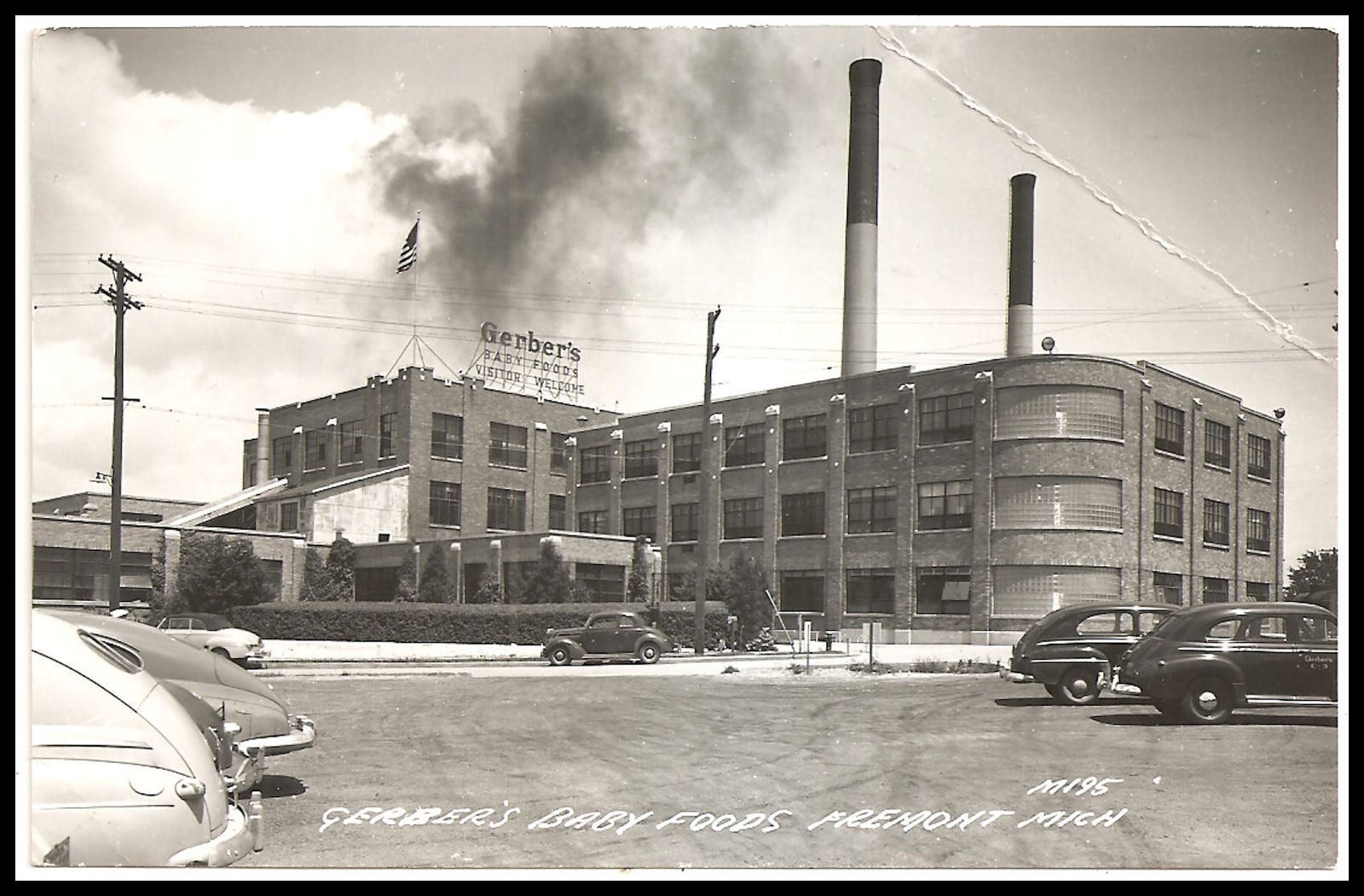
Maybe you are less sensitive than me, but I read it as look how far you’ve fallen, you unnatural, brainwashed monster mommy, forcing your helpless babes to choke down oats before their time. And God help you if you sullied their bodies with a jar of Gerber.
.jpg)
But let’s be frank here, the boomer babies fared a lot better than their Victorian counterparts. Juxtaposed against a chart of infant mortality for the same period, this chart would tell an entirely different story.
Inventing An Argument
Up to this point, everything I have said about Inventing Baby Food is about the first 35 pages. I actually found the rest of the book quite good. It shows how the rise of the baby food industry and ideas of modernity and infant care intersected in the mid-to-late of the twentieth century. The book, that is to say, is not about baby led weaning at all, save for a few paragraphs near the end about the latest feeding trends.
Like a lot of history, though, it has been repurposed, and not necessarily to great effect. Solid Starts takes Dr. Bentley’s research and then makes a few reaches with it, arguing:
“Before the invention of perfectly smooth baby food, babies were exposed to a wider variety of textures. Further, because straining baby food was so labor intensive, it's not hard to imagine that babies may have eaten finger foods earlier in their solid food journey than babies did in the 1950s.”
This sentence has no citation and there is a reason for that. It’s because it’s not in the book. Babies were not necessarily exposed to a wider variety of textures—think of those Victorian milk babies, for one. This pulled quote is on the level of Ancient Aliens history. (“The pyramids were pretty labor intensive to build. It’s not hard to imagine aliens might have done it.”)
Saying things like “it’s not hard to imagine” is a placeholder for a lack of evidence. Sure, it might not be hard for you to imagine, but our historical predecessors lived different lives, with different concepts of labor and hardship. Not to mention, it’s not that difficult to mash a lot of first foods for babies or make a simple porridge. Indeed, many moms used to prechew food for their babies through the sixteenth century, as Dr. Bentley and Wood note, not strain steamed peas.
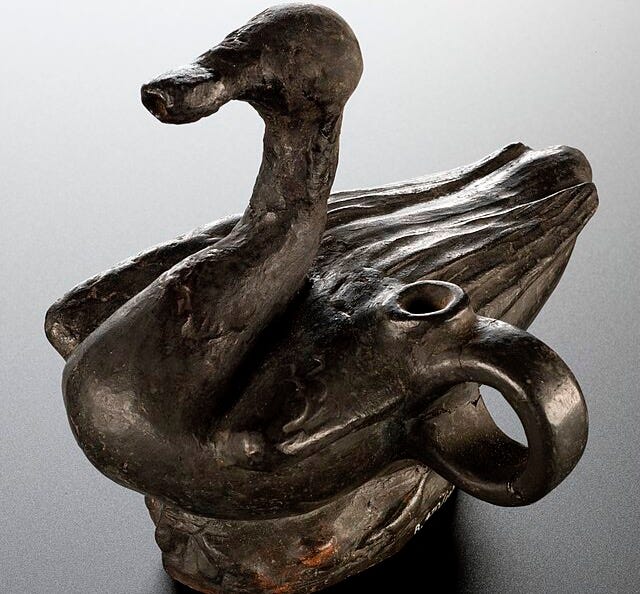
In fact, Dr. Bentley convincingly argues that fruits and vegetables were not considered good foods for babies in the nineteenth century due to their dangers. Research on ancient babies backs this up. As one study on Bronze Age (3000-4000 years ago) populations notes: “weaning foods were most likely cereal/legume pulp mixed with dairy and perhaps honey.” Not that labor intensive after all.

Solid Starts uses Dr. Bentley’s chart in an article on the rise of picky eating to obvious effect. It notes that picky eating has been on the rise for “quite some time.” But honestly, if I were just feeding my kids bread, grains, milk, and honey—some of the main components of ancient through nineteenth century weaning diets, they might not seem so picky either.
To be clear, I am not against baby led weaning in the least. I think it’s a perfectly fine option. I am against the misguided arguments and implied guilt that come packaged with it. By all means, feed your baby from your own plate. Just don’t do it thinking it’s some kind of primordial prophylactic against pickiness or an inherent approach to perfect weaning.
.jpg)
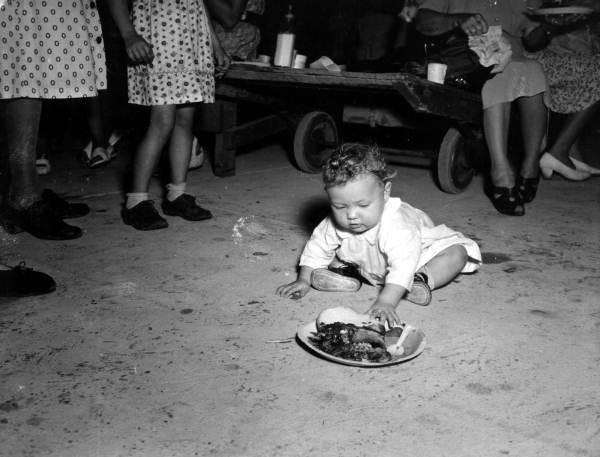
One of the main arguments of Dr. Bentley’s work is that perhaps the most salient constants in baby feeding is the pressure that moms face and the anxiety they hold about nourishing their babies. Especially in light of this acknowledgement, the use of her book to provoke more anxiety is unfortunate.
Dr. Bentley states in the introduction: “At base, infants are incredibly resilient creatures and it’s hard to inflict serious damage on a baby as long as you feed him or her sufficiently, and provide care, protection, and love” (p. 20).
Let that be your take away.
Here are some things I found just poking around without access to an academic library. Trigger warning for baby skeletons and graves. “Discovery of prehistoric baby bottles shows infants were fed cow’s milk 5,000 years ago,” by Julie Dunn; “How breastfeeding sparked population growth in ancient cities” by Chris Stantis; “Bone study sheds new light on the history of Britain's weaning habits” by the University of Aberdeen. There are also suggestions that weaning was different between male and female babies and especially urban populations versus others. Another indication that sweeping statements about weaning are tough to make.
Great, and fascinating article. Thank you.
Critiques don’t get more thoughtful than this, well done Robynne 👏🏻👏🏻👏🏻👏🏻👏🏻👏🏻👏🏻👏🏻